Choosing the right water treatment chemicals is not just a purchasing decision. It directly affects treatment efficiency, sludge volume, operating cost, equipment stability and discharge compliance.
For many industrial plants, wastewater problems do not come from a lack of chemicals. They come from using the wrong chemical, the wrong dosage or the wrong combination of products. A coagulant may reduce turbidity but fail to form strong flocs. A flocculant may work in one wastewater stream but perform poorly in another. A defoamer may control foam quickly but disappear too fast in continuous operation.
This guide explains the main types of industrial water treatment chemicals, how they work and what buyers should consider before placing a bulk order.
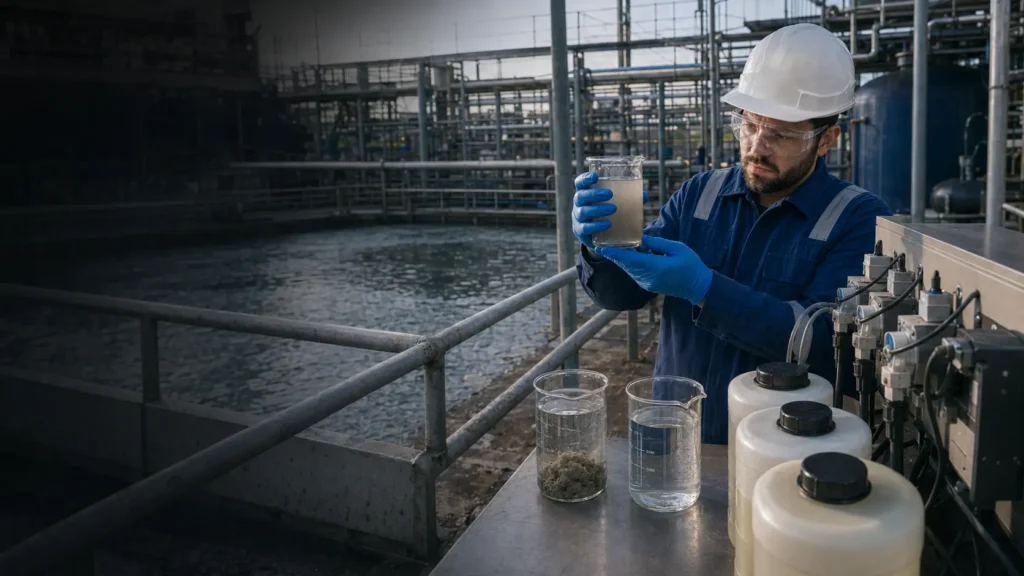
What Are Water Treatment Chemicals?
Water treatment chemicals are products used to remove suspended solids, organic matter, color, oil, foam, heavy metals and other impurities from water or wastewater. They are widely used in municipal sewage treatment, textile wastewater, paper mill wastewater, mining wastewater, food processing wastewater and other industrial systems.
Common chemicals for water treatment include coagulants, flocculants, defoamers, pH adjustment chemicals, disinfectants, scale inhibitors and sludge conditioning agents.
In many industrial wastewater treatment systems, three product groups are especially important:
- PAC絮凝剂
- Polyacrylamide flocculant
- Industrial defoamer
These products are often used together to improve clarification, sedimentation, sludge dewatering and foam control.
1. Coagulants: The First Step in Particle Removal
Many particles in wastewater are too fine to settle by themselves. They remain suspended because they carry similar surface charges and repel each other. Coagulants help neutralize those charges so small particles can come together.
One widely used coagulant is polyaluminium chloride, also known as PAC. PAC is commonly used in water and wastewater treatment because it can help reduce turbidity, suspended solids and color.
PAC絮凝剂 is often applied in:
- Municipal wastewater treatment
- 工业废水处理
- 纺织废水处理
- 造纸厂废水处理
- 采矿废水处理
For buyers, the key is not only the PAC content. Basicity, insoluble matter, pH range, dosage and wastewater type can all affect performance.
2. Flocculants: Building Larger and Stronger Flocs
After coagulation, flocculants help small particles form larger flocs. These larger flocs settle faster and are easier to remove by sedimentation, flotation, filtration or sludge dewatering equipment.
Polyacrylamide, often called PAM, is one of the most widely used flocculants in wastewater treatment. Depending on the charge type, PAM can be divided into anionic polyacrylamide, cationic polyacrylamide and nonionic polyacrylamide.
Anionic PAM is often used for inorganic suspended solids, mineral processing and some industrial wastewater systems. Cationic PAM is commonly used for sludge dewatering and wastewater containing organic matter. Nonionic PAM is suitable for specific systems where the charge condition is less obvious.
For industrial buyers, choosing the right polyacrylamide flocculant usually requires sample testing. The best product is not always the one with the highest molecular weight. It is the one that forms stable flocs at a reasonable dosage in your actual wastewater.
3. Defoamers: Solving Foam Problems Before They Disrupt Operation
Foam is a common problem in wastewater treatment plants. It may appear in aeration tanks, biological treatment systems, textile wastewater, paper mill wastewater and chemical processing wastewater.
An 工业消泡剂 is used to break existing foam and reduce new foam formation. Silicone defoamers are widely used because they can act quickly at low dosage.
Foam should not be treated as a small visual problem. Excessive foam can reduce oxygen transfer, cause overflow, affect sensors, increase maintenance work and make the whole system less stable.
When selecting a defoamer, buyers should consider foam type, water temperature, pH, compatibility with the process and whether the product needs fast knockdown or long-lasting control.
How Water Treatment Chemicals Work Together
In real treatment systems, one chemical rarely solves everything. PAC, PAM and defoamers often work as part of a complete treatment process.
A typical process may work like this:
First, PAC is added to destabilize fine particles. Then PAM is added to form larger flocs. After that, solids are removed by sedimentation, flotation or filtration. If foam appears during the process, a defoamer can be added to improve operating stability. Finally, sludge dewatering chemicals may be used before mechanical dewatering.
This is why choosing water treatment chemicals one by one is not enough. Buyers should consider the whole treatment process and how each chemical interacts with the others.
Common Mistakes When Buying Water Treatment Chemicals
One common mistake is choosing the lowest price per ton. A cheaper product may require a higher dosage, which can increase the actual treatment cost.
Another mistake is using the same chemical grade for all wastewater types. Textile wastewater, mining wastewater and municipal sludge may require completely different PAM grades.
Some plants also ignore mixing conditions. Even a good flocculant can fail if the mixing speed is too high, too low or if the dosing point is not suitable.
A fourth mistake is not retesting when wastewater quality changes. Production changes, seasonal changes and raw material changes can all affect chemical performance.
How to Choose a Reliable Water Treatment Chemicals Supplier
A good water treatment chemicals supplier should do more than sell products. They should help buyers select suitable grades, compare dosage, understand application limits and reduce trial-and-error cost.
Before choosing a supplier, buyers should check:
- Product range and application experience
- Technical specifications
- 样品供应情况
- 批次一致性
- 包装选项
- 出口经验
- Communication and technical support
For international buyers, stable supply and clear documentation are also important. Product quality, packaging, delivery time and after-sales communication can all affect long-term cooperation.
结语
Water treatment chemicals are essential for improving wastewater treatment efficiency, reducing suspended solids, controlling foam and improving sludge dewatering. However, the right product depends on the actual wastewater condition, treatment equipment and operating target.
For most industrial systems, PAC coagulant, polyacrylamide flocculant and industrial defoamer are key products to evaluate first. The best approach is to test samples, compare dosage and select chemicals based on total treatment performance rather than only unit price.
Jinxiang Chemical supplies industrial water treatment chemicals for municipal wastewater, textile wastewater, paper mill wastewater, mining wastewater, sludge dewatering and other industrial applications. Contact our team to discuss your water treatment requirements and choose suitable chemical products for your system.
常见问题
What are the most common water treatment chemicals?
Common water treatment chemicals include coagulants, flocculants, defoamers, pH adjustment chemicals, disinfectants and sludge conditioning agents. PAM, PAC and defoamers are widely used in industrial wastewater treatment.
What is the difference between PAC and PAM?
PAC is a coagulant used to destabilize fine particles, while PAM is a flocculant used to form larger flocs. In many systems, PAC and PAM are used together.
How do I choose the right chemicals for wastewater treatment?
The right choice depends on wastewater type, pH, suspended solids, COD, sludge characteristics and treatment equipment. Sample testing is recommended before bulk purchase.
Why does chemical dosage matter?
Too little chemical may lead to poor treatment results. Too much chemical may increase cost and create secondary problems such as sticky sludge or excessive residual chemicals.
[…] For broader context on how polymers work with coagulants and other treatment chemicals, see this water treatment chemicals guide, then connect the final recommendation to the sludge dewatering solution […]