Barite powder is one of the most widely used materials in drilling mud. Its main function is simple but critical: it increases drilling fluid density and helps balance formation pressure during oil and gas drilling.
For buyers, however, choosing barite powder is not only about asking for the lowest price. Poor-quality barite may cause unstable mud weight, excessive solids, poor suspension, equipment wear or inconsistent drilling performance. In some projects, the wrong grade can also create problems with specification compliance.
This guide explains how barite powder works in drilling mud, what buyers should check before purchasing and how to avoid common sourcing risks.
What Is Barite Powder?
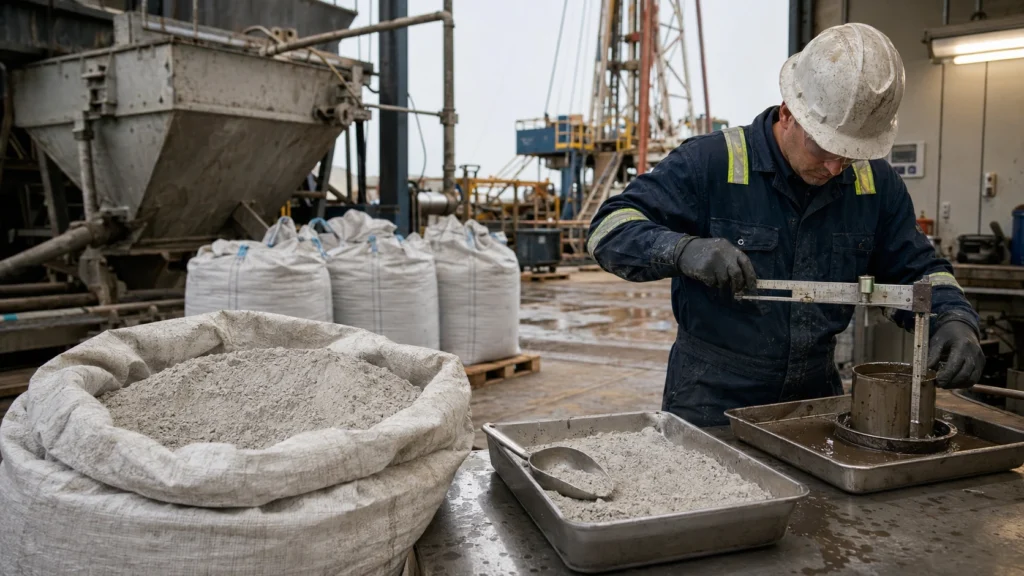
Barite is a naturally occurring mineral mainly composed of barium sulfate. In oilfield applications, it is processed into powder and used as a drilling fluid weighting agent.
Compared with many other materials, barite has high density, low chemical reactivity and good availability. These properties make barium sulfate powder suitable for increasing mud weight without significantly changing the chemical behavior of the drilling fluid system.
In simple terms, barite powder helps make drilling mud heavier.
Why Barite Is Used in Drilling Mud
During drilling, the mud column must provide enough hydrostatic pressure to control formation fluids and maintain wellbore stability. If mud density is too low, the well may face pressure control problems. If density is too high, it may increase the risk of formation damage or lost circulation.
Barite drilling mud is used when the system needs a higher mud weight. By adding barite powder, drilling engineers can adjust density more accurately according to formation pressure and drilling program requirements.
Barite is commonly used in:
- Oil and gas wells
- High-pressure formations
- Deep wells
- Water-based drilling fluids
- Some oil-based and synthetic-based mud systems
It is usually part of a broader drilling fluid additives package that may also include CMC, xanthan gum, shale inhibitors, lubricants and fluid loss additives.
API Barite: What Buyers Should Understand
In oilfield purchasing, buyers often ask for API barite or drilling-grade barite. This usually means the product should meet the technical requirements specified by the drilling project, mud company or relevant API-based purchasing standard.
For buyers, the important point is not only seeing the word “API” on a quotation. You should confirm the actual specification sheet and test results.
Common items to check include:
- Specific gravity
- Particle size distribution
- Moisture
- Purity
- Insoluble matter
- Heavy metal limits, when required
- Packaging and batch consistency
Different projects may require different barite grades. Some buyers request 4.1 SG barite, while others may require 4.2 SG or other project-specific standards. Always confirm the required specification before placing a bulk order.
Density Control: Why Specific Gravity Matters
Specific gravity is one of the most important indicators for barite powder. The higher the specific gravity, the more efficiently the material can increase drilling mud density.
If the specific gravity is lower than required, more material may be needed to reach the target mud weight. This can increase solids content and may affect mud rheology, pumpability and overall drilling fluid performance.
For this reason, buyers should not compare barite only by price per ton. A cheaper product with lower density may cost more in actual use because it requires a higher dosage.
A reliable barite supplier should provide consistent product quality and clear test data for each batch.
Particle Size and Suspension Performance
Particle size also matters. Barite powder must be fine enough to remain suspended in the mud system, but not so fine that it creates handling, dust or excessive rheology problems.
Poor particle size control may lead to settling, sagging or inconsistent mud density. In field operations, this can affect pressure control and create drilling risks.
When buying barite powder for drilling mud, buyers should check whether the supplier can provide a suitable mesh size and particle size distribution for the intended application.
Common Problems Caused by Poor-Quality Barite
Poor barite quality can cause several problems in drilling operations.
One common issue is inconsistent mud weight. If product density or purity varies from batch to batch, the mud system becomes harder to control.
Another issue is excessive impurities. Impurities may affect mud properties, increase solids loading or create compatibility problems with other drilling fluid chemicals.
A third issue is poor packaging or moisture control. Moisture can affect handling, storage and product flowability. Damaged packaging can also cause material loss during transport.
For international buyers, these problems are often expensive because replacement, testing and shipping delays can affect project schedules.
Barite Powder vs. Other Weighting Materials
Barite is not the only weighting material used in drilling fluids, but it is one of the most common options because of its density, cost and availability.
Other weighting materials may be selected for special conditions, but barite remains widely used in many conventional drilling systems.
For most buyers, the key question is not whether barite can increase mud weight. The key question is whether the selected barite powder meets the project specification and performs consistently in the mud system.
How to Choose a Barite Supplier
Choosing a reliable barite supplier is especially important for bulk oilfield purchasing. Barite is often bought in large quantities, so quality consistency, packaging and delivery capability matter.
Before selecting a supplier, buyers should check:
- Product specification sheet
- Batch test report
- Specific gravity
- Particle size
- Packaging options
- Export experience
- Delivery capacity
- Quality consistency
- Communication and documentation
For international projects, suppliers should also understand export documentation, bulk shipment requirements and project specification compliance.
Jinxiang Chemical supplies barite powder for drilling mud and other oilfield chemicals for water-based drilling fluid systems.
Buying Risks to Avoid
The first risk is buying only by price. Low-cost barite may have lower specific gravity, unstable quality or higher impurities.
The second risk is not confirming the required specification. If the project requires API barite or a specific density grade, the product must be checked before shipment.
The third risk is ignoring logistics and packaging. Barite powder is heavy, and poor packaging can lead to moisture, leakage or handling problems.
The fourth risk is assuming all barite powder is the same. Industrial barium sulfate powder and drilling-grade barite powder may not meet the same performance requirements.
Final Thoughts
Barite powder is a key drilling fluid weighting agent used to control mud density and support pressure balance during drilling. For oilfield buyers, the right product should provide suitable specific gravity, stable quality, proper particle size and reliable packaging.
When purchasing barite drilling mud materials, buyers should focus on total performance rather than only unit price. API specification, density, purity, supplier experience and batch consistency should all be checked before a bulk order.
Jinxiang Chemical supplies drilling-grade barite powder for oilfield drilling fluid applications. Contact our team to discuss your required specification, packaging and bulk supply needs.
FAQ
What is barite powder used for in drilling mud?
Barite powder is used as a drilling fluid weighting agent. It increases mud density and helps balance formation pressure during drilling.
Is barite the same as barium sulfate?
Barite is a naturally occurring mineral mainly composed of barium sulfate. In drilling applications, it is processed into powder and used as a weighting material.
What is API barite?
API barite usually refers to drilling-grade barite that meets project or API-based purchasing requirements. Buyers should confirm the exact specification required for their drilling program.
Why does barite specific gravity matter?
Specific gravity affects how efficiently barite can increase mud density. Lower-density barite may require a higher dosage and increase total solids in the mud system.
How do I choose a barite supplier?
Check product specifications, specific gravity, particle size, batch consistency, packaging, export experience and supplier communication before purchasing.