Oil-Based Drilling Fluid Emulsification Additive
Primary Emulsifier | Primary Emulsifier for Oil-Based Drilling Fluids
A core emulsification additive for stable water-in-oil systems, improved electrical stability and reliable OBM performance.
Primary emulsifier, also called the main emulsifier in an oil-based mud system, is one of the key additives used to create and maintain a stable water-in-oil emulsion. In an invert emulsion drilling fluid, the oil phase is continuous while brine is dispersed as fine droplets. Without an effective emulsifier package, those droplets can coalesce, the emulsion can weaken and overall mud performance may become unstable.
Puyang Jinxiang Chemical supplies Primary Emulsifier for Oil-Based Mud for international drilling-fluid customers. The product is designed for use in oil-based drilling fluid systems together with secondary emulsifiers, organophilic bentonite, lime, brine and other OBM components.
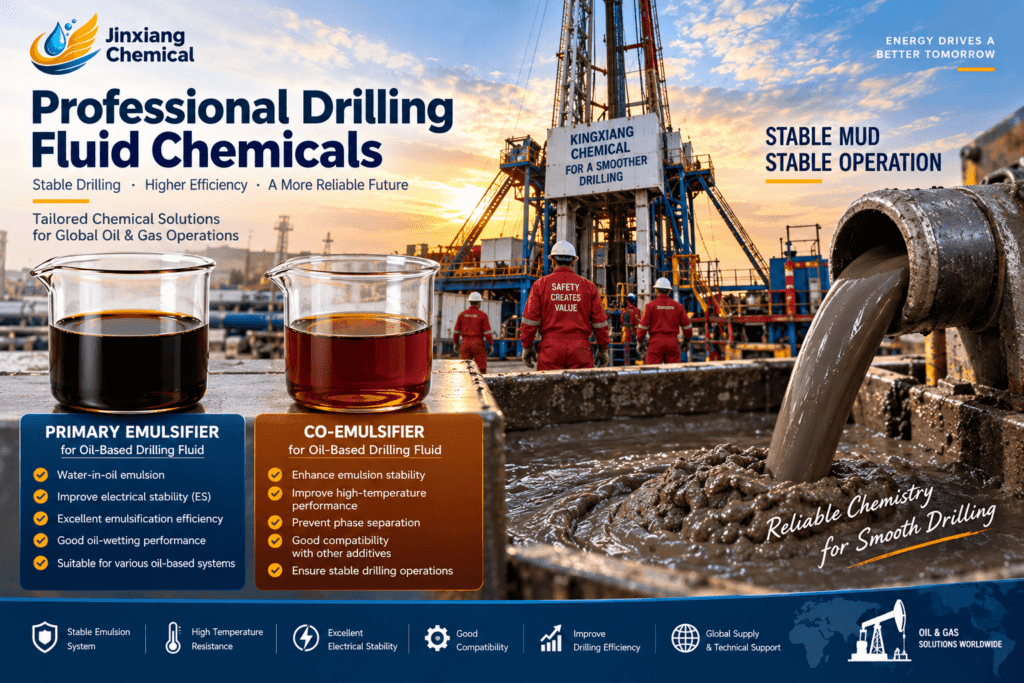
What Is a Primary Emulsifier?
A primary emulsifier is a surface-active chemical used to reduce oil-water interfacial tension and form a stable interfacial film around dispersed brine droplets. This allows the internal water phase to remain finely distributed inside the continuous oil phase.
In a properly formulated OBM system, the primary emulsifier is responsible for establishing the basic emulsion structure. Other additives then support rheology, filtration, alkalinity, density and thermal stability.
1. Building a Stable Water-in-Oil Emulsion
The most important function of a primary emulsifier is to create a stable invert emulsion. Fine brine droplets should remain uniformly dispersed in the base oil instead of merging into larger droplets or separating into a free-water phase.
A stable emulsion helps maintain predictable rheology and filtration behavior and supports consistent performance while the mud is circulated, heated and contaminated with drilled solids.
2. Supporting Electrical Stability
Electrical Stability, or ES, is commonly used as one indicator of emulsion quality in oil-based drilling fluids. A stronger interfacial film and better droplet dispersion generally support higher and more stable ES values.
However, ES should never be used as the only criterion when selecting or evaluating an emulsifier. Oil-water ratio, brine composition, lime level, solids content, temperature, rheology and filtration behavior must also be considered.
3. Improving High-Temperature Emulsion Stability
As downhole temperature increases, emulsifier demand can change and the emulsion may become more difficult to maintain. A suitable primary emulsifier should continue to provide effective interfacial protection within the intended operating range.
For deep or high-temperature wells, the full system should be tested after hot rolling rather than judging emulsifier performance only from fresh laboratory mud.
4. Supporting Wellbore Stability
Oil-based mud is often selected for shale-rich and water-sensitive formations because it limits direct contact between formation clays and the aqueous phase. A stable invert emulsion helps preserve this advantage by keeping brine droplets isolated within the continuous oil phase.
The emulsifier therefore contributes indirectly to shale protection and wellbore stability by maintaining the integrity of the OBM structure.
5. Supporting Filtration Performance
Primary emulsifiers also influence filter-cake quality and fluid-loss behavior because emulsion stability affects how the oil, brine and solids interact. In a properly balanced system, strong emulsification can support lower and more consistent filtration.
Final filtration performance still depends on the complete formulation, including organophilic clay, fluid-loss additives, solids loading and oil-water ratio.
Primary Emulsifier vs. Secondary Emulsifier
| Product | Main Role | Typical Contribution |
|---|---|---|
| Primary Emulsifier | Builds the basic water-in-oil emulsion | Main emulsification, droplet stabilization, ES support |
| Secondary Emulsifier | Strengthens and conditions the emulsion | Additional interfacial stability and system robustness |
These products are often used together rather than as direct substitutes. Jinxiang Chemical also supplies Secondary Emulsifier for OBM and Multifunctional Emulsifier for different oil-based drilling-fluid requirements.
How Primary Emulsifier Works with Organophilic Bentonite
Organophilic Bentonite is used to build viscosity, gel strength and suspension in oil-based mud. The emulsifier and organophilic clay perform different jobs: the emulsifier stabilizes the oil-water interface, while the clay builds rheological structure.
A well-designed OBM therefore balances emulsifier concentration and organophilic-clay loading instead of using one to compensate for deficiencies in the other.
Typical Product Performance
For Jinxiang Chemical primary emulsifier, typical commercial evaluation may include product appearance, emulsification performance and electrical stability in a defined laboratory formulation. A commonly used target for the primary-emulsifier grade is an emulsification rate of at least 90% and ES of at least 600 V under the specified test conditions.
Actual results depend on base oil, oil-water ratio, brine composition, lime concentration, temperature, solids and laboratory method. The applicable batch COA and agreed test conditions should therefore be used for final acceptance.
Where Is Primary Emulsifier Commonly Used?
Typical applications include conventional oil-based mud, invert emulsion mud, shale drilling, directional and horizontal wells, deep wells, water-sensitive formations and drilling programs where stable emulsion performance and lubricity are important.
How to Select the Right Primary Emulsifier
Selection should be based on the complete drilling-fluid system. Important factors include base oil type, oil-water ratio, brine salinity, calcium chloride concentration, temperature, mud density, solids content, target ES and filtration performance.
Buyers should avoid selecting an emulsifier only by price or by one ES number. A product that delivers high ES but poor rheology, excessive treatment demand or unstable filtration may not be the best overall choice.
How Should It Be Tested?
A useful laboratory test should prepare an OBM formulation close to the actual field system. Evaluate electrical stability, rheology, filtration, emulsion appearance and performance before and after hot rolling.
Where possible, test the primary emulsifier together with the intended secondary emulsifier, organophilic bentonite, lime and brine package, because interaction among these components strongly affects final mud performance.
What Information Should Be Included in an RFQ?
For a more accurate recommendation, provide the base oil type, oil-water ratio, brine composition, target ES, maximum operating temperature, mud density, existing emulsifier package, quantity, packaging and destination port.
If replacing another product, its TDS, COA or existing OBM test data can help define the comparison target.
Frequently Asked Questions
What is the main function of a primary emulsifier?
Its main function is to create and stabilize the water-in-oil emulsion in an oil-based drilling-fluid system.
Is primary emulsifier the same as secondary emulsifier?
No. The primary emulsifier builds the main emulsion structure, while the secondary emulsifier typically strengthens and conditions that emulsion.
Does a higher ES always mean a better emulsifier?
No. ES is important, but rheology, filtration, temperature stability and treatment demand must also be evaluated.
Can primary emulsifier be used without organophilic bentonite?
They perform different functions. The final requirement depends on the OBM design, but organophilic bentonite is commonly used for rheology and suspension.
Should the emulsifier be tested after hot rolling?
Yes, especially for high-temperature or demanding wells where fresh-mud results alone may not reflect field performance.
What information is needed for product selection?
Base oil, oil-water ratio, brine salinity, temperature, mud density, target ES and existing formulation are the most useful starting points.
Need a Primary Emulsifier for Oil-Based Drilling Fluids?
Send your base oil, oil-water ratio, brine system, temperature, target ES, required quantity and destination port for product information and quotation.