Oilfield Rheology Additive for OBM
Organophilic Bentonite for Oilfield Applications
A rheology and suspension additive for oil-based mud and invert-emulsion drilling fluids, supporting viscosity, gel strength and barite suspension.
Organophilic bentonite for oilfield applications is widely used in oil-based mud (OBM) and invert-emulsion drilling-fluid systems to build viscosity, gel strength and suspension capacity. Unlike conventional water-dispersible bentonite, organophilic bentonite is surface-treated so it can disperse and develop structure in oil-based media.
Puyang Jinxiang Chemical supplies Organophilic Bentonite for Oil-Based Mud and High-Temperature Organic Bentonite for different OBM requirements. These products are commonly used together with Primary Emulsifier, Secondary Emulsifier, lime, brine and weighting materials in oil-based drilling-fluid systems.
What Is Organophilic Bentonite?
Organophilic bentonite is a modified clay designed to swell and build a three-dimensional structure in non-aqueous systems. In oil-based drilling fluids, this structure contributes to viscosity, gel strength and the suspension of dense solids.
Its performance depends on the base oil, oil-water ratio, emulsifier package, shear history, temperature and chemical environment. For this reason, organophilic bentonite should be evaluated as part of the complete OBM formulation rather than as an isolated additive.
1. Building Viscosity in Oil-Based Mud
One of the primary functions of organophilic bentonite is to increase viscosity in the continuous oil phase. This helps the mud carry drilled cuttings and maintain stable rheology during circulation.
The required concentration depends on the desired rheological profile. Too little product may lead to weak suspension, while excessive treatment can increase pump pressure and make the mud unnecessarily thick.
2. Increasing Gel Strength
Gel strength is important when circulation stops. During connections, trips or other static periods, the mud must keep weighting material and drilled solids suspended.
Organophilic bentonite helps form a weak gel structure that supports solids during static conditions. When circulation resumes, that structure should break down sufficiently to allow efficient pumping.
3. Supporting Barite Suspension
Barite is commonly used to increase mud density, but because it is a dense mineral, it can settle if the mud does not have enough low-shear structure. Organophilic bentonite helps support barite suspension and can reduce the risk of sag in a properly balanced OBM system.
Barite suspension still depends on mud density, particle-size distribution, oil-water ratio, temperature and total solids loading. Organophilic bentonite is one part of the overall rheology package.
4. Supporting Hole Cleaning
A stable rheology profile helps transport drilled cuttings to surface, especially in directional and horizontal wells where cuttings beds can form more easily. By contributing to low-shear carrying capacity, organophilic bentonite can support hole cleaning when used at an appropriate concentration.
5. Helping Maintain OBM Structure
Oil-based drilling fluids depend on a stable interaction between the continuous oil phase, dispersed brine, emulsifiers, rheology modifiers and solids. Organophilic bentonite provides the structural network needed to suspend solids and support consistent rheology.
It does not replace the emulsifier package. Instead, it works together with the primary and secondary emulsifiers, which are responsible for stabilizing the water-in-oil emulsion.
Organophilic Bentonite and Emulsifiers
| Additive | Main Function | Role in OBM |
|---|---|---|
| Organophilic Bentonite | Rheology and suspension | Builds viscosity, gel strength and barite suspension |
| Primary Emulsifier | Main emulsification | Forms and stabilizes the water-in-oil emulsion |
| Secondary Emulsifier | Additional emulsion support | Strengthens interfacial stability and system robustness |
| Lime | Alkalinity and emulsifier support | Helps maintain the chemical environment required by the emulsifier package |
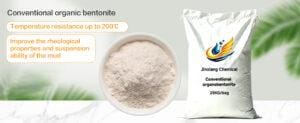
Conventional vs. High-Temperature Organophilic Bentonite
Different wells require different thermal stability. Conventional organophilic bentonite can be suitable for many standard OBM systems, while high-temperature grades are designed for more demanding thermal conditions.
Selection should not be based only on a nominal temperature rating. Laboratory testing after hot rolling is important because base oil, emulsifier package, brine content and solids can all influence high-temperature rheology.
How to Select the Right Grade
Important factors include base oil type, oil-water ratio, brine salinity, mud density, expected temperature, solids loading and target rheology. A product that performs well in one base oil may behave differently in another.
Buyers should compare apparent viscosity, plastic viscosity, yield point, gel strengths and suspension after conditioning rather than judging the product only by appearance or powder fineness.
How Should Organophilic Bentonite Be Added?
Proper dispersion is important. The product should be introduced under sufficient shear so the treated clay can disperse and develop its rheological structure. The order of addition and emulsifier package can also affect performance.
In laboratory testing, it is useful to keep mixing time, shear rate and formulation sequence consistent so that different grades can be compared fairly.
How to Test Organophilic Bentonite
A representative OBM test should evaluate rheology before and after hot rolling. Useful parameters include apparent viscosity, plastic viscosity, yield point, 10-second and 10-minute gel strengths, barite suspension and visual stability.
If the product is intended for a high-density mud, suspension performance should be tested at the actual or representative mud weight.
What Information Should Be Included in an RFQ?
For a more accurate recommendation, provide the base oil type, oil-water ratio, brine composition, mud density, maximum operating temperature, current rheology, current organophilic-clay dosage, target performance, required quantity, packaging and destination port.
If replacing another product, providing the existing TDS, COA or OBM test data can make technical comparison more efficient.
Frequently Asked Questions
What is organophilic bentonite mainly used for?
It is mainly used to build viscosity, gel strength and suspension in oil-based and invert-emulsion drilling fluids.
Can organophilic bentonite suspend barite?
Yes, it supports barite suspension, but final sag control depends on the full rheology package and mud conditions.
Is organophilic bentonite the same as regular bentonite?
No. Organophilic bentonite is surface-modified to work in oil-based systems, while conventional bentonite is primarily water-dispersible.
Does it replace the primary emulsifier?
No. Organophilic bentonite controls rheology and suspension, while the primary emulsifier stabilizes the water-in-oil emulsion.
When should a high-temperature grade be used?
High-temperature grades should be considered when thermal conditions are demanding and conventional products cannot maintain the required rheology after conditioning.
Should the product be tested before field use?
Yes. Testing in the actual or representative OBM formulation is the best way to confirm rheology, suspension and compatibility.
Need Organophilic Bentonite for Oilfield Applications?
Send your base oil, oil-water ratio, mud density, temperature, target rheology, required quantity and destination port for product information and quotation.