In the drilling of deep wells, high-temperature wells, shale formations, and complex oil and gas wells, oil-based drilling fluids are widely used due to their excellent lubricity, shale inhibition capabilities, and thermal stability.
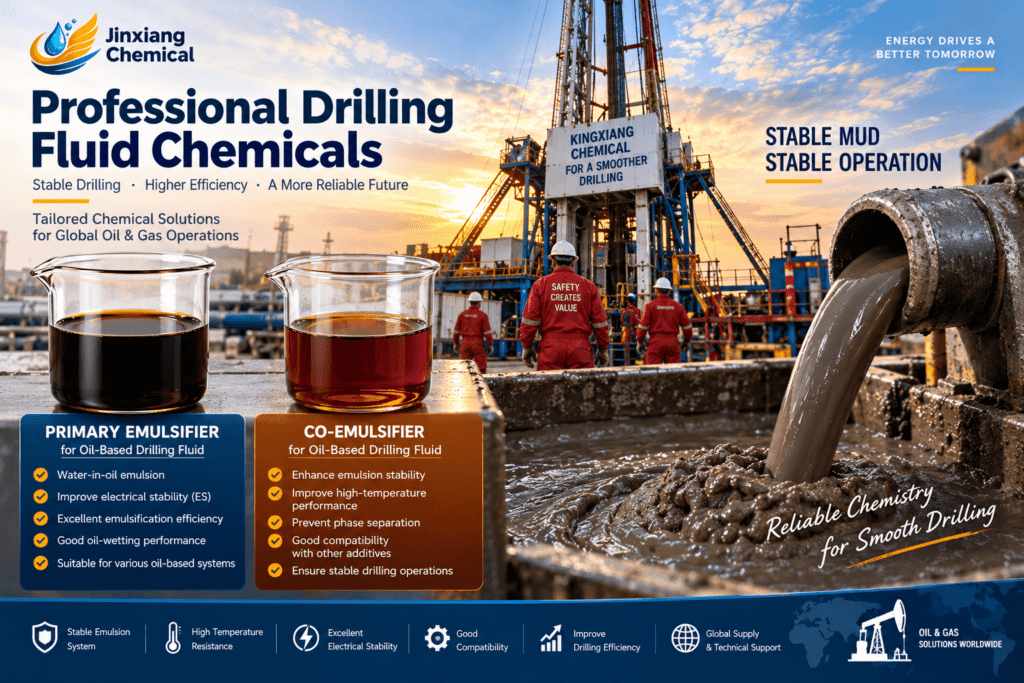
A critical component in establishing a stable oil-based drilling fluid system is the primary emulsifier.
The primary emulsifier plays a pivotal role in facilitating the formation of a stable water-in-oil emulsion between the oil and water phases, enhancing emulsion stability, and ensuring the drilling fluid maintains reliable performance in complex downhole environments.
What is a primary emulsifier for oil-based drilling fluids?
Oil-based drilling fluids typically employ diesel, mineral oil, or other base oils as the continuous phase and brine as the dispersed phase.
Under normal conditions, oil and water do not form a long-term stable emulsion.
Primary emulsifiers facilitate the formation of a stable water-in-oil emulsion system by reducing the oil-water interfacial tension and creating a stable interfacial film around the water droplets, thereby allowing fine water droplets to disperse uniformly within the continuous oil phase.
Consequently, they can be considered one of the core chemical additives in oil-based drilling fluid emulsion systems.
The primary function of the primary emulsifier
- Establishing a stable water-in-oil emulsion
This is the primary function of a primary emulsifier. Under the action of the emulsifier, brine is uniformly dispersed as fine droplets within the base oil, maintaining a relatively stable water-in-oil structure.
A stable emulsion system helps maintain the overall performance of the oil-based drilling fluid.
- Enhancing emulsion stability
Downhole, drilling fluids are subjected to various factors such as high temperatures, high pressures, shear forces, and solid-phase contamination.
High-quality primary emulsifiers form a stable oil-water interfacial film, reducing the likelihood of water droplet coalescence and oil-water separation, thereby enhancing the stability of the emulsion system.
- Improving electrical stability (ES)
Electrical Stability (ES) is a key parameter for evaluating the emulsion stability of oil-based drilling fluids.
A stable water-in-oil emulsion generally requires maintaining an appropriate level of electrical stability.
By improving the oil-water interfacial film and the emulsion structure, primary emulsifiers help enhance the system’s ES performance.
It should be noted that ES is not the sole indicator of oil-based drilling fluid performance; comprehensive evaluation should also consider factors such as the oil-water ratio, rheological properties, filtration characteristics, temperature, and solid-phase content.
- Improving system stability in high-temperature environments
As well depth increases, bottom-hole temperatures often rise.
High temperatures can compromise emulsion stability, leading to issues such as oil-water separation and changes in rheological properties. Emulsifiers designed for high-temperature oil-based drilling fluids must maintain effective emulsification and interfacial stability within the target temperature range.
Therefore, temperature resistance is a critical factor when selecting emulsifiers for deep and high-temperature wells.
- Helping to improve wellbore stability
A stable oil-based drilling fluid system minimizes direct contact between the aqueous phase and water-sensitive formations.
This is a key reason why oil-based drilling fluids excel at maintaining wellbore stability in shale formations. By preserving a stable water-in-oil emulsion structure, primary emulsifiers indirectly help the drilling fluid maintain effective shale inhibition and wellbore stability.
For which drilling environments are primary emulsifiers suitable?
Primary emulsifiers for oil-based drilling fluids can be used in a variety of OBM and invert-emulsion drilling fluid systems, and are particularly suitable for:
- Oil-based drilling fluid (OBM)
- Invert emulsion drilling fluid
- Deep-well drilling
- High-temperature wells
- Shale formations
- Water-sensitive formations
- 定向井和水平井
- Complex oil and gas well drilling
The actual formulation should be determined through laboratory compatibility testing based on the base oil type, oil-to-water ratio, brine composition, temperature, density, and other drilling fluid additives.
Typical Product Specifications for Primary Emulsifiers
| Test Items | Typical indicators |
|---|
| Product Name | Primary emulsifier for oil-based drilling fluids |
| Product Form | liquid |
| Key Features | Formulate and stabilize water-in-oil emulsions. |
| Emulsification rate | ≥90% |
| Electrical Stability (ES) | ≥600 V |
| Application system | Oil-Based Mud / Invert Emulsion Mud |
| Key Applications | Oil and Gas Well Drilling |
*Specific ES test results depend on the experimental formulation, oil-to-water ratio, temperature, brine system, and test method; the test conditions agreed upon by both parties and the actual batch Certificate of Analysis (COA) shall prevail.
What is the difference between primary emulsifiers and co-emulsifiers?
In oil-based drilling fluid systems, primary emulsifiers and secondary (auxiliary) emulsifiers typically perform distinct yet complementary roles.
The primary emulsifier is primarily responsible for establishing and maintaining a stable water-in-oil emulsion, serving as the core additive of the emulsification system.
Secondary emulsifiers are generally used to further enhance emulsion stability, improve oil-water interfacial properties, and help the system withstand high temperatures, solid-phase content, and other complex downhole conditions.
In practical oil-based drilling fluid formulations, the two are often used in combination based on system requirements, rather than simply substituting for one another.
How do you choose the right primary emulsifier?
When selecting a primary emulsifier for oil-based drilling fluids, one should not focus solely on price.
It is more important to evaluate it based on the specific drilling fluid system:
For example: emulsion stability, electrical stability, temperature resistance, oil-water ratio, and compatibility.
Puyang Jinxiang Chemical Co., Ltd. (China) offers a primary emulsifier specifically designed for oil-based drilling fluids, suitable for both oil-based muds and invert emulsion drilling fluid systems.
Supplied as a liquid emulsion, the product is easy to formulate and add on-site; customers can select the appropriate grade based on specific requirements such as base oil type, oil-to-water ratio, and target fluid properties.
We provide Certificates of Analysis (COA), Technical Data Sheets (TDS), Safety Data Sheets (SDS), and relevant technical documentation to support the operations of oilfields, drilling fluid service companies, and drilling chemical distributors worldwide.
Primary Emulsifier—creates stable water-in-oil emulsions, ensuring reliable oil-based drilling fluid performance.
Puyang Jinxiang (China)—Oil-based drilling fluid chemicals for challenging well conditions.