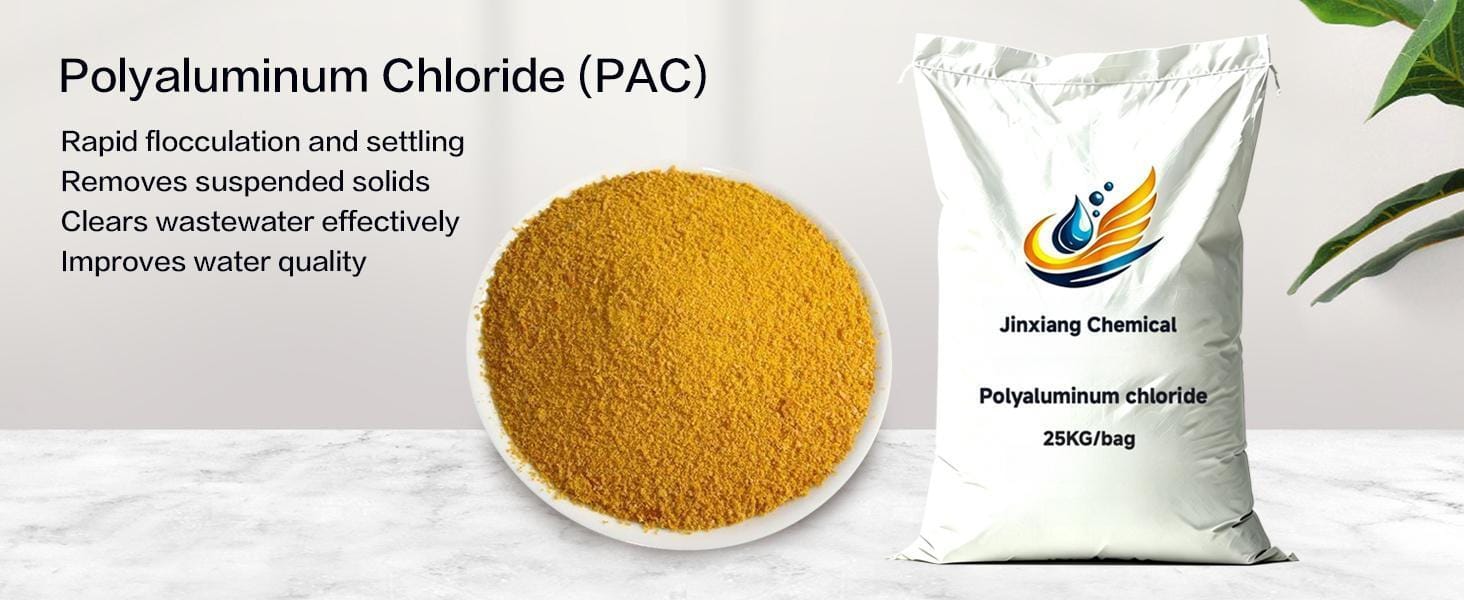
Présentation du produit
Polyaluminium Chloride (PAC)
is primarily used to remove suspended solids, colloidal particles, color, and certain organic pollutants from water.
Upon addition to water, PAC rapidly hydrolyzes to form hydroxy-aluminium polymers with strong charge-neutralization and adsorption capabilities. Through mechanisms such as charge neutralization, adsorption bridging, and sweep flocculation, it destabilizes finely dispersed particles and aggregates them into larger flocs, thereby enhancing the efficiency of sedimentation, dissolved air flotation (DAF), and subsequent solid-liquid separation processes.
Compared to traditional aluminium-based coagulants, PAC offers advantages such as rapid floc formation, excellent settling characteristics, broad applicability across various water qualities, and ease of operation. It is widely used in industrial wastewater treatment, municipal sewage treatment, and water treatment systems for sectors including mining (mineral processing), coal washing, papermaking, and textile printing and dyeing.
Depending on specific raw water and wastewater conditions, Jar Tests can be conducted to determine the optimal PAC grade, dosage, and combined application strategy with polyacrylamide (PAM), ensuring stable treatment performance and cost-effective chemical usage.
Caractéristiques du produit
- Rapid coagulation
- Effectively reduces water turbidity
- Helps remove suspended solids and colloidal particles
- Adapts to various industrial wastewater conditions
- Can be used in conjunction with PAM
- Suitable for various treatment processes, such as sedimentation and dissolved air flotation (DAF)
- Product selection recommendations available based on specific water quality
Key Application Areas
Industrial Wastewater Treatment
- Used for coagulation-sedimentation and solid-liquid separation in industrial wastewater, such as that from chemical processing.
Mining and Mineral Processing Wastewater
- Facilitates the rapid aggregation of fine mineral particles, enhancing sedimentation and clarification efficiency.
Coal Washing Wastewater
- Used for treating coal slurry water to improve the settling efficiency of suspended coal slime particles; often used in conjunction with APAM.
Pulp and Paper Wastewater
- Used to reduce suspended solids and turbidity, and to assist subsequent biochemical or sludge treatment processes.
Textile Printing and Dyeing Wastewater
- Used for coagulation and turbidity removal, as well as to help reduce color and pollution load.
Traitement des eaux usées municipales
- Applicable to processes such as coagulation-sedimentation and enhanced phosphorus removal; specific product grades and dosage rates should be determined based on water quality testing.
Conditionnement
- 25 kg woven bags or kraft paper composite bags
- Emballage OEM disponible
- Custom branding and labeling supported
- Store in a cool, dry, and well-ventilated area; prevent moisture absorption and package damage.
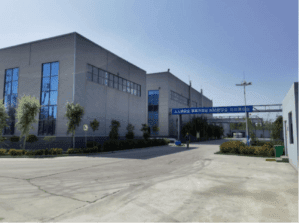
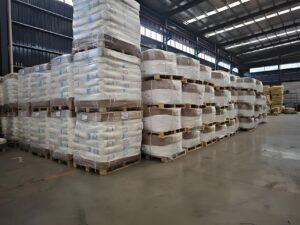
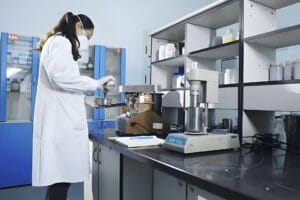
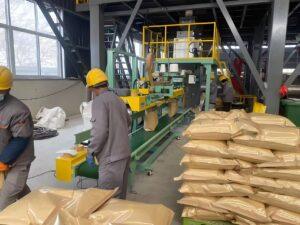
Vue de l’usine
Questions fréquentes
1. What is the primary function of Polyaluminium Chloride (PAC)?
PAC is a widely used inorganic polymer coagulant. It is primarily used to remove suspended solids, colloidal particles, turbidity, and certain organic substances from water. It promotes the formation of flocs from impurities, allowing them to settle and thereby improving water quality.
2. In which water treatment sectors is PAC primarily used?
PAC is used in the treatment of industrial wastewater, municipal sewage, textile dyeing wastewater, papermaking wastewater, mining wastewater, and other industrial water applications. The appropriate grade should be selected based on the specific water quality and application requirements.
3. What is the Al₂O₃ content of PAC?
We offer PAC grades with Al₂O₃ content ranging from approximately 26% to 30%. Specific specifications can be selected based on the customer’s water quality, application, and treatment requirements.
4. How does PAC work?
When added to water, PAC destabilizes fine suspended solids and colloids through mechanisms such as charge neutralization, adsorption bridging, compression of the electrical double layer, and sweep flocculation. This causes the particles to aggregate into larger flocs, facilitating subsequent sedimentation or filtration.
5. What is the difference between PAC and Polyacrylamide (PAM)?
PAC is primarily a coagulant used to destabilize colloids and fine particles. PAM typically acts as a flocculant, using polymer bridging to promote the aggregation of small flocs into larger floc clusters. The two are often used in combination in water treatment projects.
6. Can PAC be used together with APAM?
Yes. A common process involves adding PAC first for coagulation, followed by the addition of a suitable APAM (based on water quality) for flocculation to form larger, more easily settleable flocs. The specific dosing sequence and dosage should be determined through testing at the Jinxiang laboratory.
7. Does higher Al₂O₃ content necessarily guarantee better treatment results?
Not necessarily. While Al₂O₃ content is a key indicator, actual treatment performance also depends on factors such as basicity, water-insoluble content, raw water pH, turbidity, temperature, and the composition of pollutants. Therefore, product performance cannot be judged solely by Al₂O₃ content.
8. How should I choose between 26%, 28%, and 30% PAC?
Different content levels correspond to different product grades and application requirements. For industrial wastewater, the appropriate grade of PAC can be selected based on cost and treatment performance; for projects requiring stricter control over water quality, solubility, and impurities, selection should be based on a comprehensive set of technical specifications rather than just the Al₂O₃ content.
9. Can PAC treat high-turbidity wastewater?
Yes. PAC is effective at coagulating water with high levels of suspended solids and colloids; however, for projects involving high turbidity or significant fluctuations in water quality, jar tests should be conducted to determine the optimal PAC grade and dosage.
10. Can PAC be used for textile printing and dyeing wastewater?
Yes. PAC can be used for coagulation, suspended solids removal, and partial color reduction in printing and dyeing wastewater; it can also be used in conjunction with flocculants like PAM, depending on the specific water quality.
11. Can PAC be used for mining wastewater?
Yes. PAC can be used for coagulation and solid-liquid separation in systems such as mine drainage and ore-washing water, helping to remove fine suspended particles. Specific treatment plans should be determined based on the mineral type and water quality analysis.
12. What is the recommended dosage for PAC?
There is no single, fixed dosage. Actual usage depends on factors such as raw water turbidity, pH, suspended solids concentration, pollutant composition, and target effluent quality; it is recommended to conduct a jar test to determine the optimal dosage.
13. Is pH adjustment required when using PAC?
This depends on the raw water conditions. PAC’s coagulation performance is influenced by pH and alkalinity; therefore, for certain types of wastewater, experiments are necessary to determine the optimal pH range and dosing conditions.
14. Should PAC be dosed directly or prepared as a solution first?
In practical applications, depending on dosing equipment and process requirements, solid PAC can be prepared into a solution of a specific concentration and then metered into the system. Specific preparation concentrations and operational procedures should be determined based on on-site equipment and product specifications.
15. What are the packaging specifications for PAC?
Standard packaging is 25 kg per bag; customized packaging is also available to meet customer needs and export/shipping requirements.
16. Can you provide the COA, TDS, and MSDS for PAC?
Yes, the COA, TDS, and MSDS can be provided. Specific technical parameters—such as Al₂O₃ content, basicity, pH, and water-insoluble matter—are subject to the actual product grade and the test results of the corresponding batch.
17. How should a customer determine which type of PAC to use?
Customers are advised to provide information regarding the application industry, raw water type, pH, turbidity, suspended solids content, currently used chemicals, and treatment objectives. For large-scale projects, it is recommended to conduct sample testing first and then determine the final product grade based on coagulation speed, floc characteristics, settling performance, supernatant quality, and unit treatment cost.