Water Treatment Polymer Guide
Polyacrylamide Flocculant — Chemical Manufacturer
A practical guide to APAM, CPAM and NPAM selection for industrial wastewater treatment, sludge dewatering and solid-liquid separation.
Polyacrylamide is one of the most widely used water-soluble polymers in industrial water treatment. Its value comes from its ability to bridge fine suspended particles, accelerate floc formation, improve settling, and support sludge dewatering. For international buyers, however, the key question is not simply “Do you supply PAM?” but which polyacrylamide flocculant is suitable for my water?
Puyang Jinxiang Chemical supplies three main water-treatment grades: anionic polyacrylamide (APAM), cationic polyacrylamide (CPAM), and nonionic polyacrylamide (NPAM). Each grade has a different charge profile and application window, so correct selection should be based on wastewater chemistry, suspended solids, sludge characteristics, treatment objectives, and laboratory testing.
Poliakrilamida Anionik (APAM)
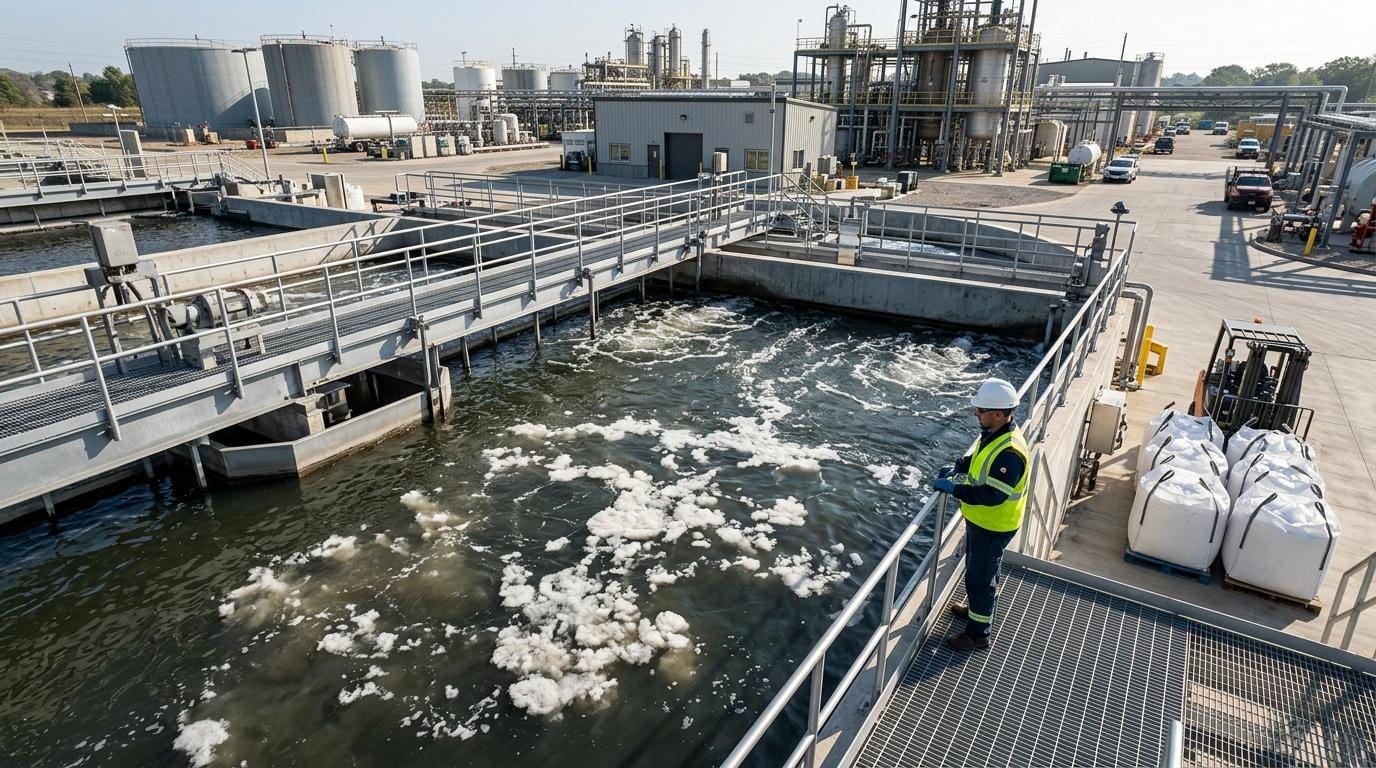
Poliakrilamida Anionik (APAM) is a high-molecular-weight water-soluble polymer commonly used where negatively charged polymer chains can bridge suspended particles effectively. It is widely considered for industrial wastewater treatment, mineral processing, coal washing, papermaking, textile wastewater, sand washing, and other separation processes.
APAM is often selected when the wastewater contains inorganic suspended solids or mineral particles and when fast settling and clarification are the main goals. In practice, dosage should be optimized by jar testing because excessive polymer can produce weak or sticky flocs and increase treatment cost.
Poliakrilamida Kationik (CPAM)
Poliakrilamida Kationik (CPAM) contains positively charged functional groups and is especially important in sludge dewatering and solid-liquid separation involving organic-rich sludge. It is commonly evaluated for municipal sludge, industrial biological sludge, filter press applications, centrifuge dewatering, and other processes where the solids carry a strong negative surface charge.
For CPAM, the buyer should pay attention not only to molecular weight but also to cationic degree. A higher cationic degree is not automatically better. The correct grade depends on sludge source, organic content, pH, dewatering equipment, and the target cake dryness.
Poliakrilamida Nonionik (NPAM)
Poliakrilamida Nonionik (NPAM) has a low ionic character and can be useful in acidic wastewater, low-turbidity suspensions, and certain industrial systems where strongly charged polymers do not provide stable flocculation. It relies mainly on adsorption and bridging rather than strong charge neutralization.
NPAM is often overlooked because APAM and CPAM are more widely discussed, but in the correct wastewater matrix it can provide more stable floc formation and better separation performance.
APAM vs CPAM vs NPAM
| Grade | Typical Strength | Common Applications |
|---|---|---|
| APAM | High molecular weight, anionic bridging | Mining, sand washing, industrial clarification, papermaking |
| CPAM | Cationic charge + flocculation | Sludge dewatering, biological sludge, filter press, centrifuge |
| NPAM | Low ionic character, adsorption bridging | Acidic wastewater, low-turbidity systems, special industrial water |
How Polyacrylamide Works in Flocculation
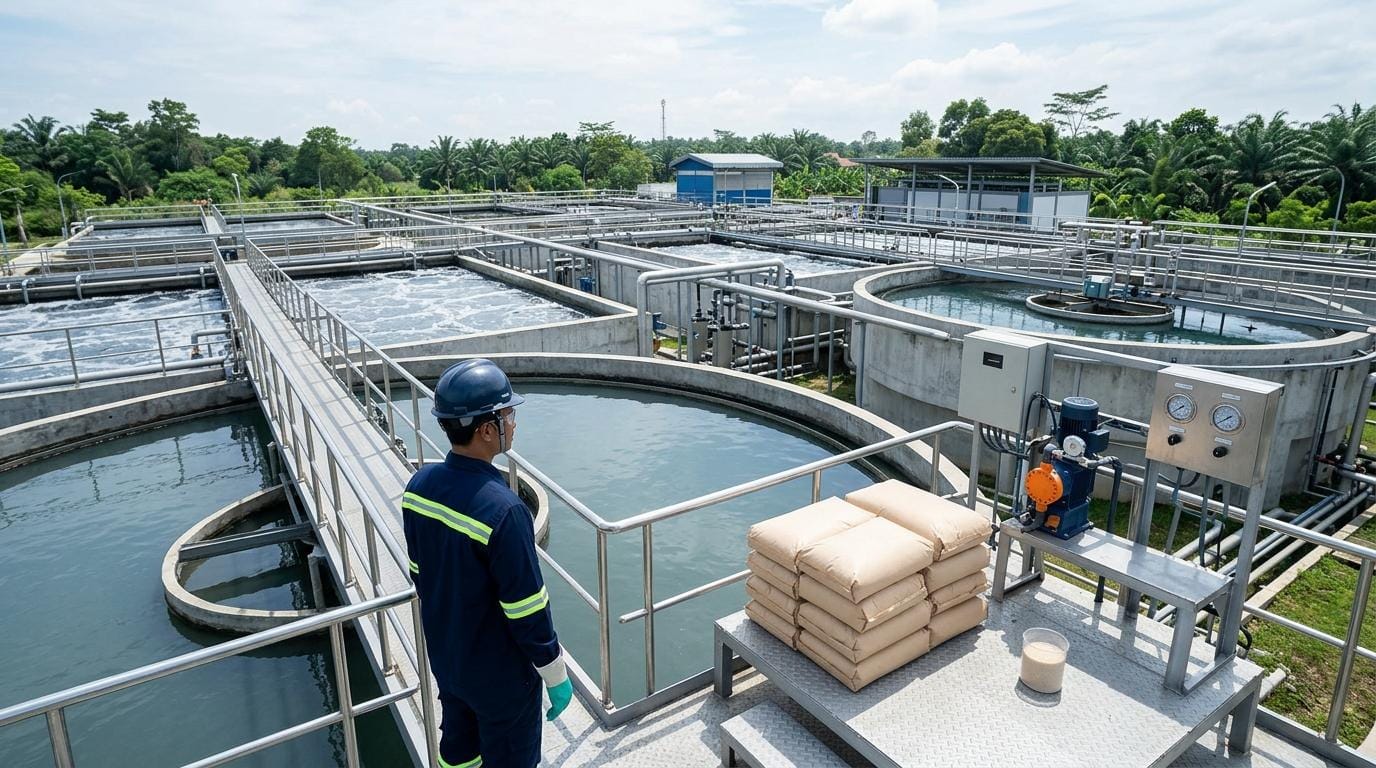
Polyacrylamide generally works by adsorption and polymer bridging. Long polymer chains attach to multiple suspended particles and create larger flocs that settle or separate more easily. In some systems, especially with cationic polymers, charge neutralization also contributes to destabilizing fine particles.
Industry references from SNF explain that high-molecular-weight flocculants increase particle size by attaching destabilized particles along polymer chains. Kemira also presents chemical flocculants as part of broader municipal and industrial water-treatment programs.
Why Jar Testing Matters
No manufacturer can select the perfect PAM grade from wastewater name alone. Two textile plants, two mines, or two sludge streams can respond differently because pH, suspended solids, conductivity, organic content, and coagulant dosage are different. A jar test helps compare grade, concentration, dosage, mixing speed, floc size, settling rate, and supernatant clarity.
For sludge dewatering, the test should also consider filtration or centrifuge response, cake formation, drainage rate, and final cake moisture. This is more useful than choosing solely by molecular weight or ionic degree.
What Should Buyers Include in an RFQ?
- Wastewater source and industry
- pH, suspended solids and major contaminants
- Current coagulant or flocculant program
- Target process: clarification, settling, thickening or dewatering
- Equipment type: DAF, clarifier, belt press, filter press or centrifuge
- Required quantity, packaging and destination port
Why Choose Jinxiang Chemical?
Puyang Jinxiang Chemical supplies APAM, CPAM and NPAM for industrial and municipal water-treatment applications. Buyers can compare the individual product pages, provide process information, and request available technical documentation and a commercial quotation based on the intended application.
Pertanyaan yang Sering Diajukan
Which PAM is best for wastewater treatment?
There is no universal best grade. APAM, CPAM and NPAM are selected according to particle charge, wastewater chemistry, sludge characteristics and treatment equipment.
Is higher molecular weight always better?
No. Molecular weight affects bridging and solution behavior, but the best grade depends on the full process. Very high molecular weight can be inefficient in some systems.
Can PAM be used together with PAC?
Yes. In many treatment programs PAC is used as a coagulant and PAM as a flocculant, but dosage and addition sequence should be optimized by testing.