Oil-Based Drilling Fluid Solutions
Skenario Aplikasi
Shale Formation Drilling
Deep & Ultra-Deep Wells
Offshore Drilling Platforms
HPHT & Complex Formations
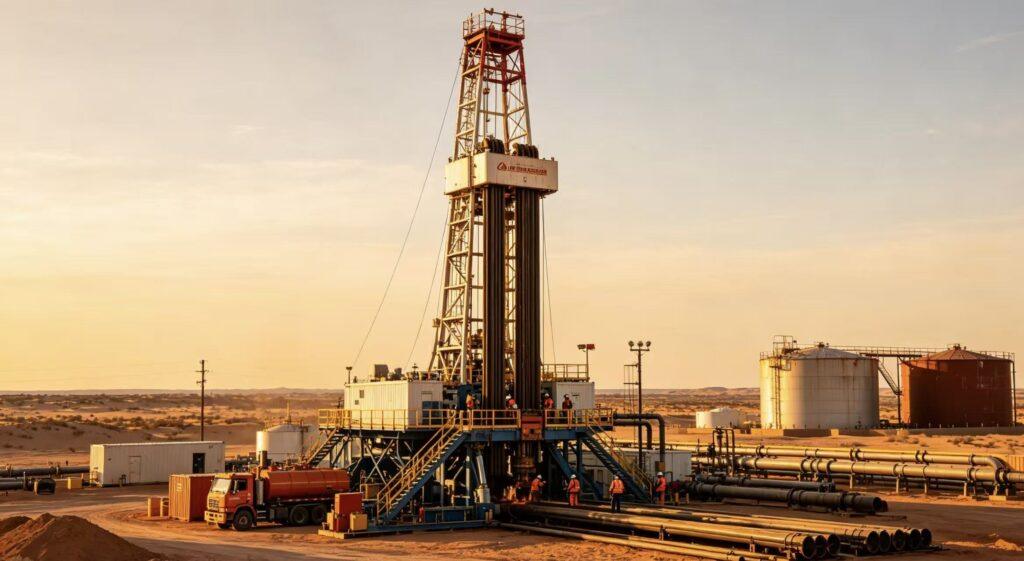
Oil-based drilling fluids use oil as the continuous phase. Invert-emulsion systems disperse a brine phase within the oil and require compatible emulsification, solids wetting, rheology and suspension. The additive package must suit the base oil, oil-to-water ratio, brine chemistry, solids loading and anticipated downhole temperature.Jinxiang Chemical supplies primary, secondary and multifunctional emulsifiers, standard and high-temperature organophilic bentonite, and weighting materials such as barite. We support product selection for compatible oil-based mud formulations used in shale formations, directional and horizontal wells, offshore operations and temperature-specific applications.
Gambaran Umum Solusi
Oil-based drilling fluids require compatible emulsification, solids wetting, rheology and suspension. The following problems are assessed in the complete mud using its actual base oil, brine and operating conditions.
Grades, dosage and operating limits depend on the complete formulation. Request the applicable TDS and confirm compatibility through laboratory testing.
Emulsion Instability, Free Water and Falling Electrical Stability
Problem and possible causes: Invert-emulsion mud relies on a stable dispersion of brine in the continuous oil phase. Free water, separation or a declining electrical stability trend can indicate a need to investigate emulsification and solids wetting. Changes in base oil, oil-to-water ratio, brine composition or solids loading can affect the system.Solution approach and product selection: Evaluate a compatible primary and secondary emulsifier package, or a suitable multifunctional emulsifier, in the complete formulation. Compare electrical stability with visual emulsion behavior, rheology and filtration results before and after aging. Use consistent test conditions; an ES value alone does not establish all aspects of mud performance.Poor Oil-Wetting and Solids Agglomeration
Problem and possible causes: Weighting materials and drilled solids must remain compatible with the oil-continuous system. Poor wetting can appear as clumps, sticky solids, uneven suspension or unexpected viscosity changes. Review the emulsifier package, water contamination and the amount and type of solids introduced into the mud.Solution approach and product selection: Screen secondary or multifunctional emulsifiers for their grade-specific wetting contribution alongside the primary emulsifier. Assess solids dispersion, emulsion stability and rheology together. Appropriate solids control and a compatible emulsifier package are both relevant; adding emulsifier without identifying contamination or excess solids may not resolve the cause.Insufficient Rheology or Excessive Gel Development
Problem and possible causes: Oil-based mud needs enough low-shear structure to suspend cuttings and weighting materials, while maintaining practical circulation properties. Unsuitable organophilic clay selection or mixing conditions can give weak suspension, excessive viscosity or progressive gels.Solution approach and product selection: Select organophilic bentonite for the actual base oil, oil-to-water ratio and temperature. Compare viscosity, low-speed rheometer readings and gel strengths after suitable mixing and aging. Standard and high-temperature grades should be evaluated in the complete fluid rather than treated as interchangeable products.Barite Sag and Uneven Mud Density
Problem and possible causes: Weighting particles can settle under static conditions or during circulation, especially in inclined well sections. Density differences and accumulation of weighting material indicate a need to assess suspension performance. Barite increases mud density; adding it does not by itself prevent sag.Solution approach and product selection: Assess static and dynamic sag behavior together with low-shear rheology and the well profile. Suitable organophilic bentonite can support the suspension structure, while barite grade and solids loading also matter. The target is stable density distribution with manageable rheology, verified through the operator’s applicable testing program.High-Temperature Changes in Emulsion and Suspension
Problem and possible causes: Temperature exposure can change emulsion behavior, viscosity, gel strengths and the suspension of solids. An acceptable result immediately after mixing may differ from the result after sustained hot aging. Both the emulsifier package and rheology modifier need to suit the expected environment.Solution approach and product selection: Evaluate high-temperature organophilic bentonite where the specific grade and TDS support its use. Confirm compatibility with the selected emulsifiers, base oil and brine. Review ES, rheology, suspension and HTHP filtration after aging; choose grades based on measured formulation performance rather than a general high-temperature label.Excessive HTHP Filtration or Water in the Filtrate
Problem and possible causes: Worsening HTHP filtration can reflect problems with emulsion stability, solids wetting or the complete filtration-control package. Review filtrate volume and character, filter cake condition and the results after aging. A viscosity measurement alone does not establish suitable filtration behavior.Solution approach and product selection: Check the emulsifier package and oil-wetting response, then evaluate the complete mud’s filtration-control design. Emulsifiers and organophilic bentonite provide supporting functions but are not universal substitutes for a dedicated oil-mud filtration additive. Identify any additional requirement through formulation testing and technical consultation.Base-Oil, Brine and Additive Compatibility During Mud Adjustment
Problem and possible causes: Changing the base oil, brine phase or weighting level can alter emulsion demand and rheology. A product performing well in one mud may respond differently in another. Contamination and changes to the existing additive package should therefore be included in screening.Solution approach and product selection: Provide the base oil, oil-to-water ratio, brine composition, density, temperature and current additive concentrations. Compare primary/secondary and multifunctional emulsifier options with suitable organophilic bentonite grades. Verify the adjusted system using ES, rheology, filtration and suspension tests before selecting a package.Contact Jinxiang Chemical with your current mud composition, test results, well conditions and required quantity for product selection support.| Nama Produk | Performance Features | Application Scope |
|---|---|---|
| Primary Emulsifier | Supports formation of an invert emulsion. | Oil-based mud formulations. |
| Secondary Emulsifier | Supports emulsion stability alongside the primary emulsifier. | Compatible invert-emulsion systems. |
| Multifunctional Emulsifier | Combines emulsification and supporting wetting functions according to grade. | Formulations verified with actual base oil and brine. |
| Organophilic Bentonite | Builds viscosity and gel structure for solids suspension. | Compatible oil-based drilling fluids. |
| High-Temperature Organophilic Bentonite | Rheology support under grade-specific elevated temperatures. | Systems verified through hot-aging testing. |
| Barite | Increases drilling fluid density. | Weighted oil-based mud systems. |
Pertanyaan yang Sering Diajukan
Can a multifunctional emulsifier replace a primary and secondary package?
A multifunctional grade may combine emulsification and supporting wetting functions, but substitution depends on its technical data and the intended base oil, brine and solids loading. Compare the candidate with the existing package through ES, rheology, filtration and aging tests before choosing a formulation.How do I choose standard or high-temperature organophilic bentonite?
Use the grade-specific TDS, actual base oil, target rheology, solids loading and anticipated temperature as the starting point. Compare suspension, gel strengths and hot-aging behavior in the complete fluid. A high-temperature product name alone does not define its suitable dosage or guarantee performance in every mud.Is there a universal emulsifier dosage or ES target?
No single dosage or ES value defines every oil-based formulation. Requirements depend on the product grade, base oil, oil-to-water ratio, brine chemistry, solids loading and the operator’s mud program. Share your current composition and test results to select a compatible package and a formulation-specific evaluation plan.Dukungan Teknis
Optimisasi Sistem Lumpur
Optimalkan sistem fluida pemboran berdasarkan kondisi geologi untuk meningkatkan stabilitas lubang sumur dan kinerja pemboran.
Pengujian Laboratorium
Evaluasi kompatibilitas cairan pemboran dan kinerja produk melalui pengujian laboratorium sebelum diaplikasikan di lapangan.
Pemilihan Produk
Rekomendasikan aditif cairan pengeboran yang sesuai berdasarkan karakteristik formasi, suhu, salinitas, dan persyaratan pengeboran.
Formulasi Khusus
Kembangkan formulasi cairan pengeboran yang disesuaikan untuk formasi yang tantangannya tinggi, sumur dalam, dan lingkungan pengeboran khusus.