Polyacrylamide Selection Guide for Water Treatment
How to Choose the Right Polyacrylamide Flocculant
Choosing between anionic and cationic polyacrylamide is not about finding the “strongest” polymer. It is about matching polymer charge, molecular structure and treatment objective to the actual wastewater or sludge in front of you.
Why the Right Polyacrylamide Grade Matters
Polyacrylamide flocculants are widely used to improve solid-liquid separation in industrial and municipal water treatment. They can help fine suspended particles form larger flocs, accelerate settling, improve clarification and support sludge dewatering. However, APAM and CPAM are not interchangeable simply because they belong to the same polymer family.
In a wastewater treatment plant, poor polymer selection often shows up as small weak flocs, slow settlement, cloudy supernatant, high chemical consumption or unstable dewatering performance. Those problems are not always caused by “low quality” polymer. They can also come from choosing the wrong charge type, unsuitable grade, poor solution preparation, incorrect dosage or an injection point that subjects the forming flocs to excessive shear.
APAM
Anionic Polyacrylamide
Commonly evaluated for clarification, sedimentation and solid-liquid separation where mineral or inorganic suspended solids are important.
CPAM
Cationic Polyacrylamide
Commonly evaluated for sludge conditioning and dewatering, especially where sludge contains negatively charged organic solids.
What Is Anionic Polyacrylamide (APAM)?
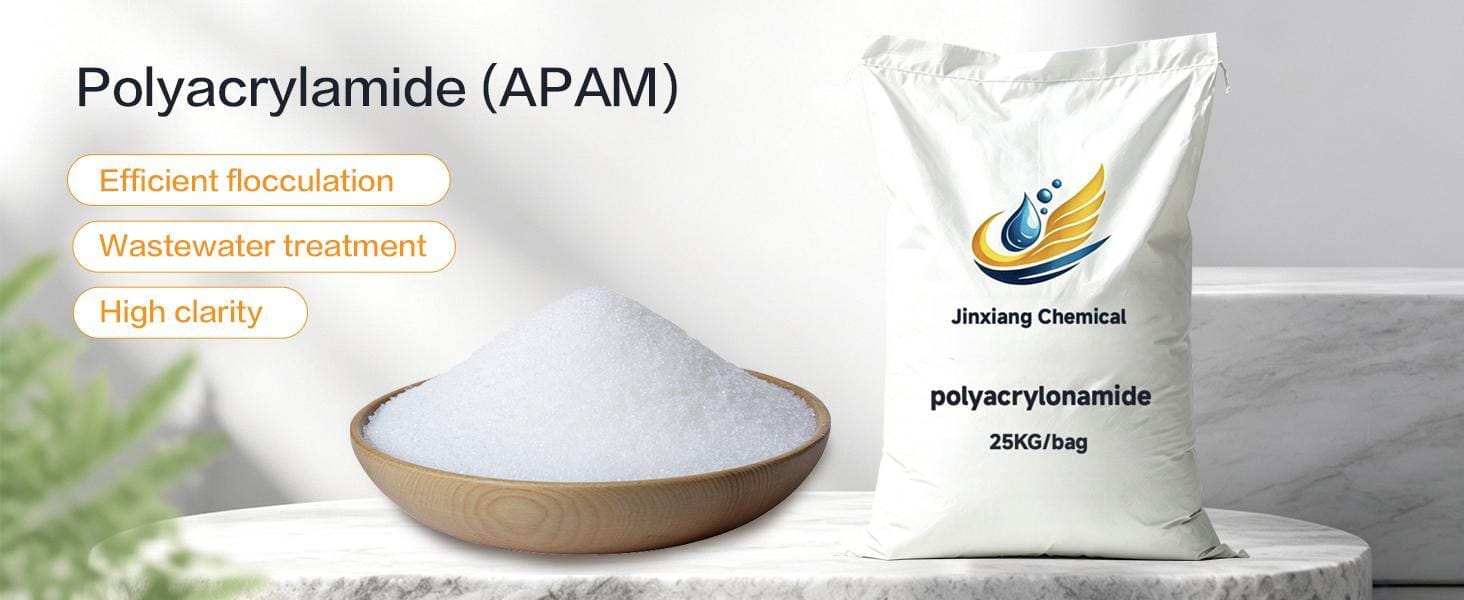
Polyacrylamide anionique (APAM) is a high molecular weight, water-soluble polymer used for flocculation, sedimentation, thickening and filtration-aid applications. In water treatment, it is often selected where suspended solids can be effectively bridged by an anionic polymer.
Typical application areas include industrial wastewater clarification, mineral processing water, coal washing, papermaking, textile wastewater and other solid-liquid separation systems. Jinxiang Chemical’s APAM product range is designed for water treatment applications where settling and clarification are key objectives.
What Is Cationic Polyacrylamide (CPAM)?
Polyacrylamide cationique (CPAM) is a water-soluble cationic polymer commonly used as a flocculant in sludge conditioning and solid-liquid separation. In many sludge dewatering applications, the cationic charge helps the polymer interact with negatively charged particles and organic matter so that stronger flocs can form before mechanical dewatering.
CPAM is frequently evaluated in sewage sludge, biological sludge and various industrial sludge streams before belt presses, screw presses or centrifuges. The correct grade depends on sludge source, solids concentration, equipment type and the chemical environment of the process.
.png)
APAM vs CPAM: The Practical Difference
The most important difference is charge. APAM carries an anionic character, while CPAM carries a cationic character. That difference affects how the polymer interacts with suspended particles and sludge. The correct choice therefore starts with the nature of the solids and the treatment target.
| Selection Factor | APAM | CPAM |
|---|---|---|
| Charge type | Anionic | Cationic |
| Common treatment goal | Clarification, settling, solid-liquid separation | Sludge conditioning and dewatering |
| Typical starting point | Mineral/inorganic suspended solids | Organic or biological sludge |
| Final confirmation | Laboratory and plant testing using the actual water or sludge | |
Start with the Treatment Objective
If the main objective is to clarify water and settle suspended solids, APAM is often a logical grade family to test first. If the main objective is to condition sludge before mechanical dewatering, CPAM is often a more relevant starting point. This is a practical screening rule, not an absolute specification.
Wastewater composition can change significantly from one factory to another. Even within one treatment plant, upstream production changes can affect polymer demand. Therefore, the best product is the one that produces stable flocs and good separation at an economical dosage under actual operating conditions.
Do Not Choose Only by Molecular Weight or Charge Density
Buyers often ask for “the highest molecular weight” or “the highest cationic degree.” That approach can be misleading. A polymer with a higher headline number is not automatically the most suitable for a specific wastewater. Performance depends on the interaction between polymer structure and the particles being treated.
A better evaluation looks at floc size, floc strength, settling rate, clarity of separated water, polymer consumption and downstream equipment performance. In sludge dewatering, cake condition and centrate or filtrate quality should also be monitored.
How PAC Fits into the Process
In many clarification systems, a coagulant such as Polychlorure d’aluminium (PAC) is used before polyacrylamide. PAC destabilizes fine colloidal particles, while APAM or another suitable polymer can then bridge those particles into larger flocs. The sequence, dosage and mixing conditions should be optimized through testing.
For a practical trial method, see our PAC and PAM Jar Test Guide. For preparation and dosing, refer to our PAM Solution Preparation and Dosing Guide.
What Information Should You Send a Supplier?
- Wastewater or sludge source
- Industry and treatment objective
- pH, TSS or solids concentration if available
- Current coagulant and flocculant
- Current dosage and treatment result
- Clarifier, DAF, belt press, screw press or centrifuge details
- Required monthly volume and destination port
This information allows a supplier to narrow the grade selection before samples are sent. It also makes the quotation more relevant to the actual project instead of treating every inquiry as the same commodity purchase.
Foire aux questions
Can APAM be used for sludge dewatering?
It can be tested in some systems, but CPAM is a more common starting point for many organic and biological sludge applications.
Can CPAM be used for wastewater clarification?
Yes, in some wastewater types. The correct choice depends on particle charge and process chemistry, so jar testing is recommended.
Which is more expensive, APAM or CPAM?
Market prices vary by grade, raw materials and specification. Procurement should compare treatment cost per cubic meter or per ton of sludge, not only price per ton of polymer.
How do I confirm the right grade?
Run laboratory screening first, then confirm the selected grade under actual plant conditions and operating equipment.
Need Help Choosing APAM or CPAM?
Send Jinxiang Chemical your wastewater or sludge type, pH, solids concentration, treatment target, current chemicals, monthly demand and destination port. We can help you identify suitable APAM or CPAM grades for laboratory evaluation and prepare technical documents and a quotation.