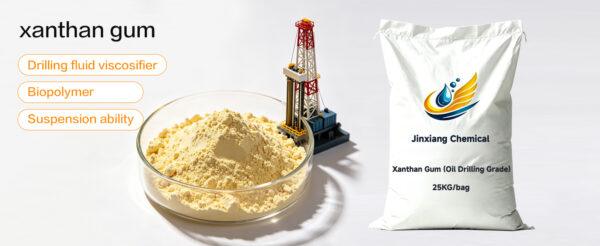
Gomme xanthane – Agent épaississant
Présentation du produit
La gomme xanthane est un biopolymère de haut poids moléculaire obtenu par fermentation microbienne, spécialement conçu pour être utilisé dans les fluides de forage pétrolier. Elle agit comme un viscosifiant très efficace, un agent de contrôle de la perte de fluide et un agent de suspension.
Ce produit conserve des propriétés rhéologiques stables dans des conditions de température élevée, de salinité élevée et de forte teneur en calcium, ce qui permet de stabiliser efficacement le puits et de faciliter l'évacuation des déblais. Il est largement utilisé dans les puits profonds, les puits directionnels, les puits horizontaux et les systèmes de fluides de forage à base de saumure.
Caractéristiques et fonctions principales
- Excellentes propriétés de fluidification sous cisaillement : viscosité statique élevée pour une suspension optimale des déblais de forage ; faible viscosité lors du pompage pour une meilleure fluidité et une efficacité de forage accrue.
- Excellente résistance thermique et à la salinité : performances stables dans des environnements à haute température et à forte salinité, ainsi que dans des systèmes de saumure saturée.
- Contrôle efficace des pertes de fluide : forme un gâteau de filtration compact et peu perméable afin de limiter l'intrusion du filtrat et de protéger la formation.
- Grande capacité de rétention des débris : met efficacement en suspension la barytine et les agents de lestage, nettoie le puits et empêche la sédimentation.
- Bonne compatibilité : compatible avec divers additifs pour fluides de forage, adapté aux systèmes à eau douce, à eau de mer et à saumure.
- Écoresponsable : biodégradable et peu toxique
Conditionnement et stockage
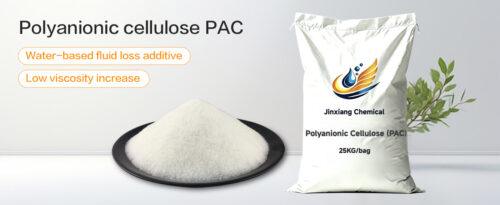
- Conditionnement : 25 kg par sac, sac en papier kraft / sac tissé avec doublure en PE.
- Conservation : À conserver dans un endroit frais, sec et aéré ; éviter l'humidité, l'exposition directe au soleil et les températures élevées.
- Durée de conservation : 2 ans dans des conditions de stockage adéquates.
- Transport : Produit non dangereux, pouvant être transporté par voie maritime et terrestre.
Méthode d'application
- Peut être ajouté directement sous forme de poudre sèche, ou dissous dans une solution à une concentration comprise entre 0,51 TP3T et 2,01 TP3T avant d'être incorporé au fluide de forage.
- Dosage recommandé : 0,11 TP3T à 0,41 TP3T par volume de boue, à ajuster en fonction de la profondeur du puits, de la température et des exigences rhéologiques.
- Mélanger soigneusement pendant l'ajout et faire circuler pendant 15 à 20 minutes jusqu'à dispersion homogène.
- Peut être utilisé en association avec du PAC, de l'amidon, de la résine de lignite et d'autres additifs pour obtenir de meilleures performances globales.
FAQ
1. What is the primary function of xanthan gum in oil-well drilling fluids?
Xanthan gum serves primarily as a viscosifier, rheology modifier, and suspending agent; it enhances the low-shear viscosity and cuttings-carrying capacity of the drilling fluid, helping to suspend drill cuttings and solid particles such as barite.
2. For which drilling fluid systems is xanthan gum primarily suitable?
It is mainly used in water-based mud (WBM) systems, including fresh water, brine, and various polymer-based systems.
3. How does xanthan gum improve cuttings-carrying capacity?
Xanthan gum offers excellent rheology modification capabilities, increasing the fluid’s viscosity and suspension performance under low-shear conditions, thereby facilitating the transport of drill cuttings from the bottom of the well to the surface.
4. Can xanthan gum prevent barite sag?
Xanthan gum enhances the suspension capacity of drilling fluids, helping to reduce the risk of settling (sagging) for barite and other solid particles. However, actual performance depends on factors such as fluid density, rheological parameters, temperature, and the overall formulation.
5. What is the difference between xanthan gum and CMC/PAC?
Xanthan gum is primarily used for viscosification, rheology modification, and improving suspension and cuttings-carrying capacity. In contrast, while CMC and PAC also adjust viscosity, they are more commonly used for fluid loss control and filter cake improvement. They can be used in combination within drilling fluid formulations as needed.
6. Can xanthan gum be used in conjunction with KCl, K-PAM, and PHPA?
Yes. In appropriate water-based drilling fluid systems, xanthan gum can be combined with additives such as KCl, K-PAM, PHPA, PAC, and CMC to achieve comprehensive performance characteristics, including rheology control, shale inhibition, encapsulation, and fluid loss control.
7. Is xanthan gum suitable for high-salinity environments?
Drilling-grade xanthan gum is generally suitable for water-based systems with certain salinity levels; however, specific salt tolerance depends on the product grade, salt type, salt concentration, and system formulation. Product TDS specifications and laboratory test results should be consulted.
8. Is xanthan gum suitable for high-temperature drilling?
Xanthan gum can be used in various drilling environments, though elevated temperatures may affect its long-term rheological performance. For high-temperature wells, aging tests should be conducted based on actual downhole temperatures, and the formulation should be determined in conjunction with high-temperature resistant additives.
9. What is the recommended dosage of xanthan gum?
The dosage should be determined based on target viscosity, wellbore size, drilling fluid density, salinity, temperature, and cuttings-carrying requirements. It is recommended to determine the optimal dosage through laboratory formulation testing; specifying a fixed dosage in product literature is not recommended.
10. Can xanthan gum be used directly as a fluid loss control agent?
Xanthan gum’s primary function is not specifically fluid loss control. If the customer’s main issue is excessive API or HTHP fluid loss, it is recommended to use it in combination with PAC, CMC, modified starch, or specialized polymer fluid loss control agents.
11. What are the packaging specifications for xanthan gum?
Standard packaging is 25 kg per bag; customized packaging is available to meet export shipping and customer requirements.
12. Can COA, TDS, and MSDS documents be provided for the xanthan gum?
Yes, technical documents such as COA, TDS, and MSDS can be provided. Specific product specifications—such as viscosity, purity, moisture content, and particle size—are subject to the actual supplied grade and batch test results.
13. Under what circumstances is xanthan gum recommended to customers?
Drilling-grade xanthan gum is highly recommended when customers encounter issues such as insufficient drilling fluid viscosity, poor cuttings-carrying capacity, inadequate low-shear suspension properties, or the tendency of solids to settle.
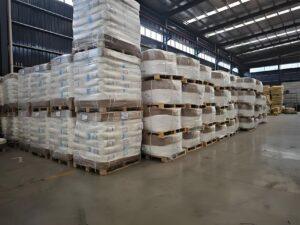
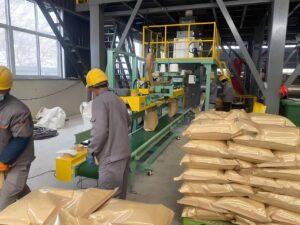
Factory scene


-500x205.jpg "Polyacrylate de potassium (K-PAM)")